High Q Microwave and Millimeter Wave Dielectric Resonators
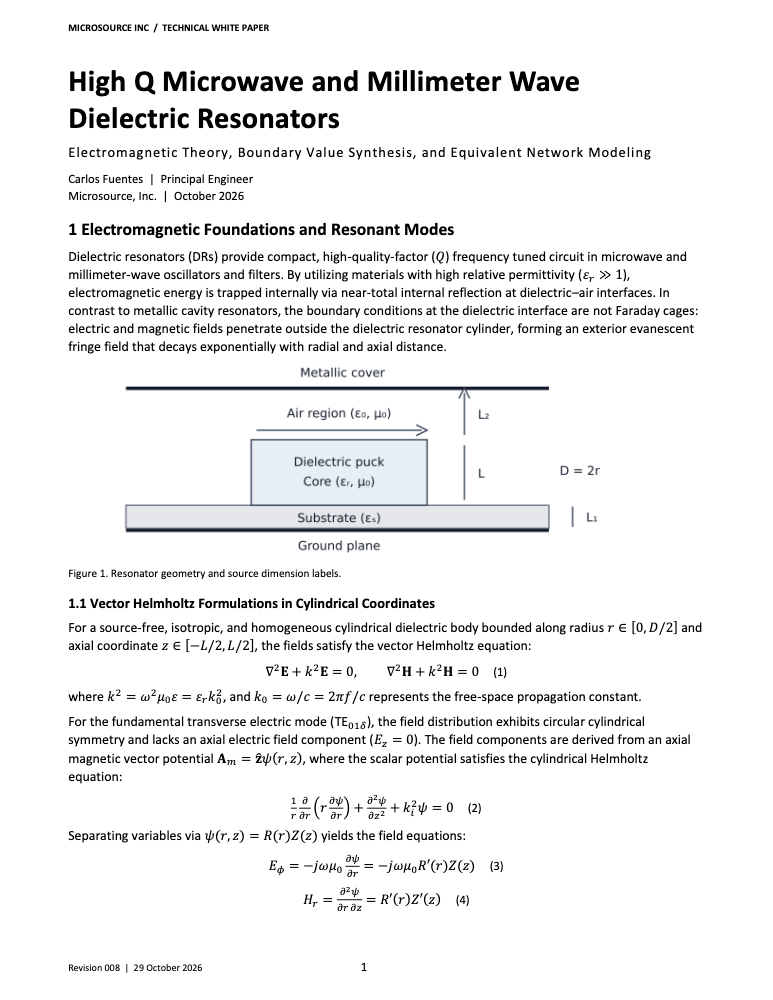
Dielectric resonators (DRs) provide compact, high-quality-factor (𝑄) frequency tuned circuit in microwave and millimeter-wave oscillators and filters. By utilizing materials with high relative permittivity (𝜀𝑟≫1), electromagnetic energy is trapped internally via near-total internal reflection at dielectric–air interfaces. In contrast to metallic cavity resonators, the boundary conditions at the dielectric interface are not Faraday cages: electric and magnetic fields penetrate outside the dielectric resonator cylinder, forming an exterior evanescent fringe field that decays exponentially with radial and axial distance.
We use your details to deliver this resource. Privacy notice
We’ll email you a secure download link. Marketing emails are optional; existing email preferences are respected.
Powered by Ballista CRM